
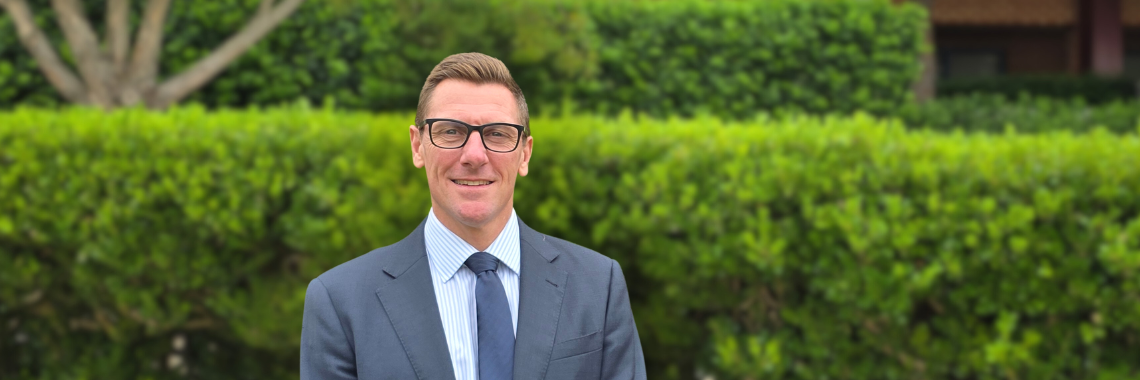
Last term finished on a great high as the College community came together to share our differences and commonalities as we celebrated Unite Week. There were many highlights across the week but perhaps the most powerful was the opportunity to sit and listen to one of our students speak about her personal experience and the opportunity that exists for each of us to promote unity on a daily basis.
As I listened to Malaika share her story, I was reminded about the power of student voice, personal experience and learning from one another. With her permission, I am delighted to share her address as I believe it is worthy of all of our attention.
Good morning, everyone. Let me start with a simple question. When you hear the word "immigrant," what comes to mind? Be honest.
For many people, it's not a person. It's a stereotype. Someone with a thick accent. Someone who struggles with English. Someone who looks different, sounds different, and somehow doesn't quite belong.
Whether we realise it or not, we often place immigrants into a box before we get to know them. People think they know what an immigrant looks like. They think they know our stories before we've even had the chance to tell them.
But I want to challenge that today. Take me, for example.
I attend a private school. I speak English. If you looked at me, the word "immigrant" probably wouldn't cross your mind.
Yet, I am an immigrant. I am Pakistani-Australian. My dad is from Pakistan, my mum is Australian, and for the first thirteen years of my life, Pakistan was not just where I was born; it was home.
Like any place, it had its challenges. We dealt with seven to eight power cuts at a time, all year round. We had to buy bottled drinking water, and sometimes got caught in dust storms. But I also grew up surrounded by family. There was always somewhere to go, someone to see, and food to be shared. It was loud, vibrant, chaotic, and full of life.
It was familiar. It was everything I had ever known.
Because my mum is Australian, I used to come here on holiday every few years. But let me tell you right now: visiting a country for two weeks and moving your entire life there are two completely different things.
I had to learn that the hard way in 2021.
Getting on that plane was one of the hardest things I have ever done. My family was flying into complete uncertainty. We didn't have a house waiting for us. My parents didn't have jobs lined up. This didn't feel like a trip. It felt like I was closing a chapter of my life and opening a new one, except I had no idea what that new chapter would look like.
Sitting in that aeroplane seat, I wasn't excited. I was terrified. I didn't know what school would be like. I didn't know if Australia would ever feel like home.
When the plane landed, the first thing that hit me wasn't the landscape. It was quiet. Coming from the organised chaos of Pakistan, the neat suburban streets of Australia felt surreal. Back home, life happened out in the open. Here, everything seemed hidden behind closed doors and manicured lawns.
For the first time in my life, I felt completely out of place. And like any thirteen-year-old, I just wanted to belong.
At first, there were plenty of cultural misunderstandings. For months, I had no idea what the word "Maccas" meant, and my friends found my confusion hilarious. I found it strange that there were no security walls around houses. In Pakistan, every house has a six-foot brick wall with a gate.
Those misunderstandings were harmless. But there is a huge difference between laughing about local slang and making assumptions about someone's intelligence, education, or worth because of where they come from or what they look like.
Unfortunately, I learned that difference pretty quickly.
I dealt with lazy jokes asking if I was related to every other South Asian student in my year group. I heard casual racial slurs, like “curry muncher”, thrown around and laughed off as harmless banter.
What struck me most wasn't even the comments themselves. It was how normal they seemed. It's always funny when it's somebody else's culture. But the moment the joke targets your own culture, suddenly it's recognised as disrespectful, hurtful, and racist.
And I want to acknowledge something important here. My story is not the hardest immigrant story. Not even close. I moved here with my family. I spoke English. I attend a private school and have been given opportunities that many people can only dream of. Some people have arrived in Australia carrying trauma I can't begin to imagine. Some have spent years in refugee camps. Some have left behind family members they may never see again. Others have arrived with nothing but the clothes on their back.
Refugees are often forced to leave their homes, not because they want to, but because staying would put their safety, freedom, or even their lives at risk. Others face discrimination in workplaces, struggle with language barriers, or spend years rebuilding a life from scratch in a country that feels completely unfamiliar.
Compared to stories like those, my journey was extraordinarily easy. And yet, even with all of those advantages, I was still placed into a box before people got to know me.
If I could be reduced to a stereotype, imagine how often that happens to people whose differences are far more visible than mine.
But here's the truth: Immigrants are not one thing. There is no single immigrant look. There is no single immigrant personality. And there is definitely no single immigrant story.
Some people move countries for work. Some move for family. Some move for education. Others arrive as refugees, forced to leave their homes because they have no other choice. In fact, many people use the words immigrant and refugee interchangeably, but they are not the same thing. One chooses to move. The other is often left with no choice at all. Those experiences are completely different.
Yet we often throw everyone into the same category and assume we understand them. We don't. Every person carries a different story.
So why do we treat immigrants as though they're all the same? And even more importantly, why do we treat them like outsiders? Because they're not.
Immigrants are not separate from Australia. They are Australia. In fact, unless you are Aboriginal or Torres Strait Islander, immigration is part of almost every Australian family's story because somebody in your family arrived here hoping for a better future.
Immigrants don't just belong in Australia. They help build it. They teach in our schools, work in our hospitals, run businesses, coach sporting teams, and share cultures, traditions, food, languages, and ideas that diversify this country, making it richer and stronger.
When the FIFA World Cup comes around, the energy in this country is unmatched. What makes Australia unique is that we get to celebrate our global roots while standing shoulder-to-shoulder for the Socceroos. Many Australians proudly cheer for their home countries while simultaneously backing the Socceroos. This dual loyalty doesn't divide us; it enriches us. Our diverse heritages make our community more vibrant, connected, and exciting.
So I want to leave you with a challenge today.
The next time you meet someone from a different background, don't rush to define them. Don't reduce them to a stereotype. Don't put them in a box before they've even had the chance to speak.
Instead... ask questions. Listen. Get to know them as a classmate, a teammate, a neighbour, or a friend.
Because when we stop dividing people into "us" and "them," we realise something important: There was never really an "us" and a "them" to begin with.
Just people. People trying to belong. People trying to build a future. People trying to find a place to call home.
Australia does not succeed despite immigration. Australia succeeds because of it.
Thank you.