
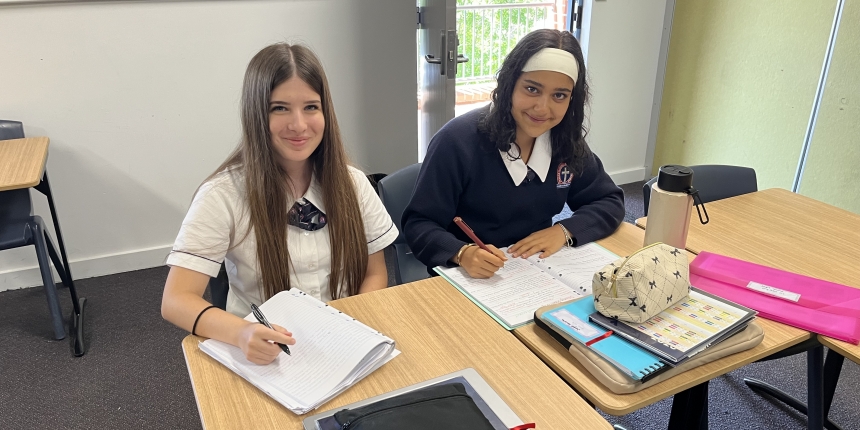
All Year 11 students have started their year’s study of English with a common focus area: Reading to Write. They are learning all about Australian voices and how to write imaginative pieces with these voices.
‘Voice’ is a technical concept in English, referring to the way that group identities are implied by the choices we make in expressing ourselves, including with the written word. This can include ethnicities, education, class, gender and stage of life, among other categories. To start appreciating how this works, students were asked to explain the structure of a celebrity voice that resonated with them.
Tijana A. wrote the following noteworthy example:
Throughout this interview, Jeff Buckley adopts an informal and conversational tone, particularly through the use of colloquial and profane language. This could suggest an anti-elitist identity, aligning him with authenticity and artistic craft as opposed to the typical idea of celebrity culture. Moreover, his consistent elaboration of his sentences and occasionally reflective tone imply a creative and introspective attitude and reflect a self-educated artistic mindset. The references he makes to artistic process, being unsatisfied with his work, and “deepening the work” demonstrate his creativity and intellectual depth. He also discusses soul bands and blue bands, positioning him within a broader American music culture. Overall, through his demeanour and tone whilst being interviewed, he projects a persona that does not value prestige or status as much as authenticity and artistic depth.
Having chosen a celebrity of interest, students proved quite capable of deconstructing how their selected voice implied so much about who they are, or at least who they are trying to be. It was equally significant that the students identified with these voices, foreshadowing where the sequence of learning was heading.
They were then asked to think specifically about Australian voices – indigenous, colonial, early national and migrant – and demonstrate, in short compositions, their understanding of the different registers or levels of formality at which these voices could appear.
Joyce H. wrote the following engaging piece:
Colloquial
Church hadn’t even ended yet, but we went straight to Sandra’s sixteenth at around 12:30. Her little sisters were running around with plates of fairy bread and hot chips while music played through a scratchy speaker, her backyard smelling of chicken on the barbie and caramelising onions. They lit the candles too early, and we all shouted at them. Sandra laughed so much we thought she was gonna cry. We took pictures with the digital cameras posing aesthetically, you know, with icing on fingers and everybody chattering away about school the week ahead. By 4:30pm, I was home, shoes off, bag on the floor, writing homework and packing lunches. The party noise faded away and the clock began ticking.
Poetic
In the afternoon, her yard was filled with a beautiful smokey smell and sweetness. The cake was cut into triangles, and the candles were lit as soft laughter floated above the fence. Sandra was wandering all over and sixteen and glowing and held by each of the voices that loved her for a moment. The afternoon felt golden and forgivingly slow. Soon I was back home in its straight lines: the desk, the lists, the folded uniforms, Monday waiting in its calm certainty. Pen glided over page as night fell. Somewhere, faint as sugar on the tongue, the echo of her birthday song remained with me.
It was then time to bring in the theory of archetypes, or the unconscious models of people and voices that we have within us, shaping how respond to the people we encounter in the world around us and the world on-line… or so the theory goes.
We have an elder archetype, down in there, that determines the father and mother figures from whom we seek approval, a hero archetype that tracks the “ideal selves” with whom we seek to identify, a shadow archetype that we despise for embodying what we reject in ourselves, a child archetype that attracts our protection, and a lover archetype… You get the idea.
The celebrity voices chosen by students earlier in the focus area took on renewed significance, because they became examples of voices that are powerful for expressing the hero archetype in a way that is specific to each individual. Having touched upon this way that voices become powerful, a deeper lesson could then be learnt.
These powerful voices constantly shape values by means that are more obscure yet more influential than information and argument. We human beings generally do not decide what we believe and what gives our life purpose by being logically persuaded, but by listening to voices that play importantly roles in our life from time to time. Applying archetype theory can help students to consciously anticipate the power of voices constructed through texts, from consumable content to literature.
The students in my class went on to apply this knowledge in composing short fiction that could move their intended audience to new perspectives or reinforce existing ones, just by carefully writing Australian voices in ways that appeal to these basic drives in all human hearts. It was a neat approach that helped them to work with an authentic purpose for their writing. But, more than that, it raised other questions about the voices we let into our heads and how these might be shaping our values right now, whether they have been constructed by artists, advertisers, or AIs.
Mr David Gawthorne
English Coordinator
